


What is Hypothalamic Amenorrhea?
Amenorrhea is the technical word used to describe when a woman does not have a natural menstrual cycle. In fact, if we literally analyze what the word means
What Do We Mean by Amenorrhea (Loss of the Menstrual Cycle)?
First of all, it is important to differentiate between two types of amenorrhea:
- Primary amenorrhea: refers to the absence of menstruation in a woman who has never menstruated naturally (without the help of medical intervention; contraceptive or hormone therapy).
- Secondary amenorrhea: refers to the absence of 3 or more menstrual cycles in a woman who has previously had natural cycles.
The causes of primary amenorrhea are usually completely different from the causes of hypothalamic amenorrhea.
There are a multitude of causes that can lead to secondary amenorrhea, such as; Asherman’s syndrome (scarring in the uterus that prevents bleeding), autoimmune diseases, various medications, thyroid problems, among many others. As well as Hypothalamic Amenorrhea, which will be the focus of attention in this article.
Characteristics of Hypothalamic Amenorrhea
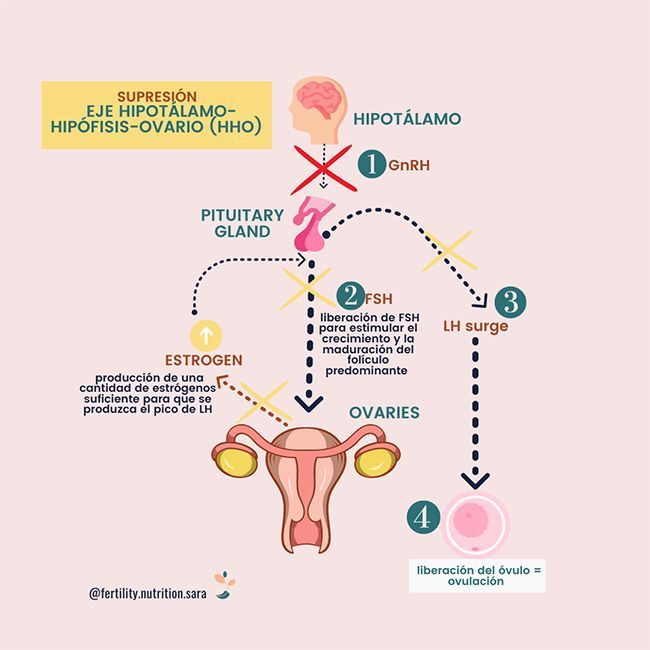
Hypothalamic amenorrhea (HA), also known as functional hypothalamic amenorrhea (FHA) or hypogonadotropic hypogonadism (HH) is a complex pathology that affects women of reproductive age and is characterized by the absence of the menstrual cycle due to a suppression of the hypothalamic-pituitary-ovarian axis (HPO).
According to the American Association of Reproductive Medicine, 3-5% of women suffer from secondary amenorrhea, with hypothalamic amenorrhea being responsible for 20-30% of the total of these cases.
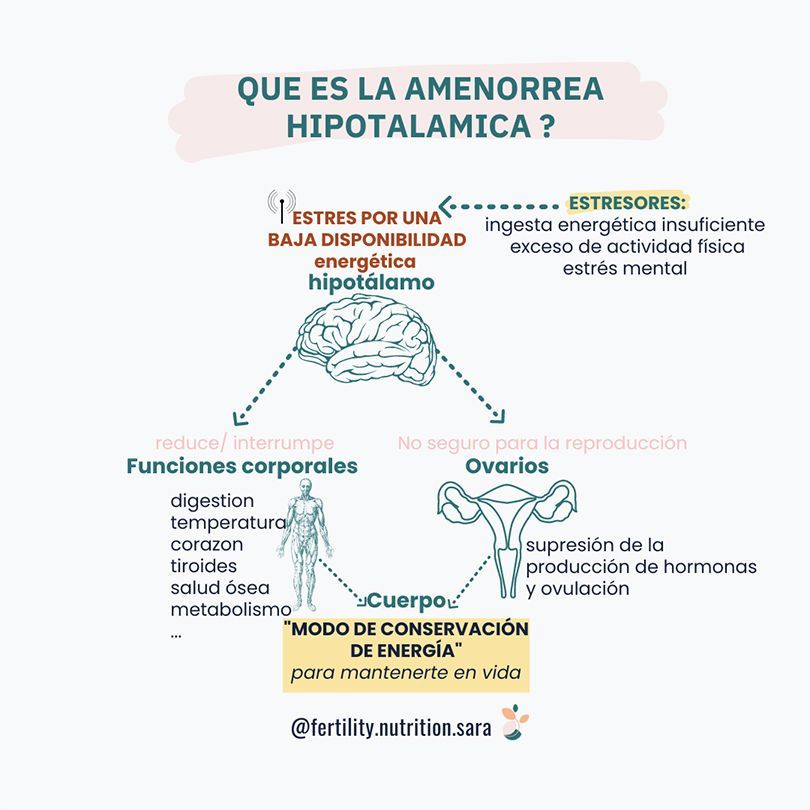
HA is the result of low energy availability (insufficient energy to cover your body’s requirements), mainly due to a voluntary or involuntary energy deficiency, excessive physical activity and/or mental stress – which in turn act as stressors for your body, thus causing a disruption in the communication between the hypothalamus, the pituitary gland (in particular the pituitary gland) and your ovaries. When this communication is interrupted, your body stops ovulating, which causes you to stop having your menstrual cycle, since your hypothalamus is not able to release the hormones that trigger ovulation.
In other words, your reproductive hormones are basically “taking a break.” When your brain stops talking to your ovaries, this means that your ovaries cannot receive hormonal messages to trigger ovulation.
Attention, you can experience HA whether you consider yourself an athlete or not! Even the practice of moderate exercise can play a role in the suppression of your reproductive system, since, as I have explained, you are most likely not providing your body with enough energy to match your activity levels.
Let’s get a Little more Scientific
The hypothalamus is a very small area of your brain (the size of an almond) which plays an essential role in maintaining the homeostasis (balance) of most of your bodily systems. It collects information from the rest of your body, including different areas of your brain, nerves from other organs, and other chemical compounds that are in your blood. It processes this information and based on this information sends a multitude of other hormones that control : food intake, body temperature, sleep, thirst, and your reproductive system.
This multitude of hormones includes gonadotropin-releasing hormone (GNHR). GnRH is responsible for the production and release by the pituitary gland of follicle-stimulating hormone (FSH) and luteinizing hormone (LH), essential for the maturation and release of the egg (ovulation) to take place. As well as, it also helps in the production of estrogen. When hypothalamic amenorrhea occurs, due to this interruption in communication between (hypothalamus, pituitary gland and your ovaries) the GnRH hormone stops being released. Consequently, if the hypothalamus stops producing and releasing the GnRH hormone, the amount of FSH, LH and estrogen is reduced or interrupted. And obviously this will trigger anovulation and therefore a cessation of menstruation. Fundamental for fertility but also for general health and well-being.
Why Don’t I Have My Period?
First of all, remember that not having a menstrual cycle is NOT NORMAL, the pill is not the solution, it is NOT only important when you want to get pregnant. When your body stops menstruating (ovulating), it means that your internal alarm system is screaming at you to warn you that something is not right and that you are not in an optimal state of health!
Main Causes of Absence of Menstruation:
Hypothalamic amenorrhea tends to appear due to 3 main causes:
- Insufficient diet: a low caloric intake or excessive weight loss
- Excessive practice of physical exercise
- High level of psychological stress
In some women, only one of these factors is enough to cause the cessation of their menstrual cycle. But in most women with HA, it is caused by a combination of these 3 factors, in which you will see a certain overlap as we review them.
Insufficient Diet: a Low Caloric Intake or Excessive Weight Loss
The regularity of our menstrual cycle depends on a minimum level of body fat. Although the exact number is not important (and varies from one woman to another), evidence shows that a minimum of 22% total body fat is required to maintain ovulatory function and regular menstruation.
When a woman adopts very restrictive and strict eating habits, thus limiting her total caloric intake, she has a greater risk of losing her menstruation. This eating pattern can be caused by an eating disorder (anorexia, bulimia, orthoreixa). It can also occur due to voluntary chronic insufficient intake (dysfunction in the relationship with food, restrictive eating, rigidity in eating habits motivated by the desire to manipulate body composition or simply by a severe concern to eat in a healthy way and even seek perfection) or involuntary (nutritional deficiencies, lack of appetite, ignorance or deficiency of correct nutritional education).
Energy balance is essential for survival. The energy we consume in the form of food fuels critical functions of our body (bombarding our heart, energizing our brain, keeping our cells working, etc.). After this, energy is used as fuel for “extra and additional things” such as: hair growth, nails, immune cells, bones, maintaining body temperature, and finally, the most DISPENSABLE: fat storage and REPRODUCTION.
The main function of your body is survival (keeping you alive, protecting you and helping you). Think about it, reproductive function is a non-ESSENTIAL function for your survival, therefore it becomes one of the last priorities your body has. Thus, if there is a caloric restriction, and there is not enough energy available to even cover the essential bodily functions, your body will respond by adapting to this energy deficit by suppressing as much as possible to continue surviving in an effort to conserve energy. The first affected will be reproduction (since your body feels that it is not a safe time to create another human).
It is also important to keep in mind that this energy must come from a variety of different sources: protein, fat and carbohydrates. Since each type of food sends different signals that work in harmony to support the function of the hypothalamus Well, yes! Caloric intake plays a critical role but it is also important to consider where these calories come from.
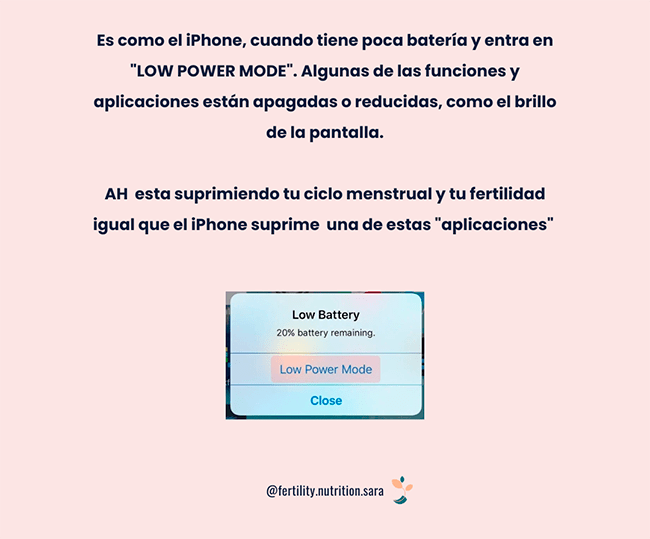
There are 2 important points that I would like to highlight regarding weight and body fat percentage:
- First, you should know that it is completely possible to lose your menstrual cycle at any weight and in any body size. Although it is more common in women who are underweight or with a low BMI, women with what we consider within the standards of “normal weight” or even above can also suffer from HA.
- Losing a significant amount of weight (5k or more), even many years ago, can contribute to the likelihood of losing your menstrual cycle.
Excessive practice of physical exercise
Exercise is another piece of the puzzle that comes into play in two different ways: firstly, due to a lack of energy, and secondly, due to an increase in stress hormones, including cortisol.
- Regarding the energy part, many of us do not eat enough to compensate for the exercise we do, which means that we operate with a caloric deficit. If we exercise several days a week or several hours a day without providing our body with enough energy, this (which is very intelligent) will respond to this chronic state of energy deficiency by suppressing our menstrual cycle (since the hormones that regulate our menstrual cycle will be at abnormal levels).
“It’s like expecting your car to drive twice the distance on half the fuel” - The second way that exercise can affect our menstrual cycle is by increasing stress hormones such as cortisol. In addition, today, there are already a multitude of studies that demonstrate that the hormones of both psychological stress and the hormones generated by exercise can have effects on menstrual cycles.
When you suffer from AH, your hypothalamus (and your ovaries) is actually protecting you
against additional stress by eliminating the possibility of pregnancy for a while. Well, your body is
warning you that reproduction is not safe now.
High level of psychological stress
Stress has a significant impact on our menstrual cycle. It can either shorten our luteal phase, delay ovulation, and in many cases, suppress ovulation.
Studies have found that women with Hypothalamic Amenorrhea tend to have “higher levels of perfectionism” than women without AH. This is true for many of us, right? This personality trait often helps us and serves us to achieve professional goals and/or achieve sports goals, for example. But the pressure we put on ourselves to meet those high expectations can also trigger a lot of stress. Then there are the normal day-to-day stressors that life can throw at us such as; those involving family, friends, work situations, etc. Stress can be helpful in some situations, but when it is chronic and particularly associated with exercise (physical stress), it can lead to changes in our brain that suppress the hypothalamus and our menstrual cycles.
In fact, studies show that women with AH have the highest levels of cortisol compared to women who have a regular menstrual cycle. Thus assuming that it could be that women with AH are more sensitive to stressful situations, or that perhaps they are more prone to a dysregulation of the axis (HHO).
That’s right, your genes are likely to play an important role in determining the sensitivity that our reproductive system presents to an energy deficit and stress.
It is important to keep in mind that for each of the women with hypothalamic amenorrhea, the combination and levels of each of these factors is different and unique. The amount of food, exercise and level of stress that causes AH varies extensively for each woman.
Diagnosis and Symptoms
Unfortunately the diagnosis of hypothalamic amenorrhea is complex and very often difficult to obtain. Well, as we mentioned at the beginning of this blog, there are a large number of potential causes of secondary amenorrhea (loss of period) which include: PCOS (Polycystic ovary syndrome), hypothalamic amenorrhea (HA), hyperprolactinemia (high levels of prolactin), thyroid disorders, autoimmune diseases, physical abnormalities, medications, among others.
Due to all these causes, it is very important that if you have lost your menstrual cycle you visit your doctor so that they can rule out some of these less common causes in order to obtain an adequate diagnosis. That’s right! The diagnosis of hypothalamic amenorrhea is a “diagnosis by exclusion.”
Some Warning Signs and Symptoms
- Loss of the menstrual cycle
- Constant thoughts about food
- Anxiety around food/ counting calories
- Feelings of guilt after eating certain foods or exceeding certain amounts
- A practice of exercise of 6-7 days a week (no rest days)// performing physical exercise as compensatory behavior
- Dietary restrictions- exclusion of certain foods or food groups from the diet
- Feeling cold all the time
- Digestive problems
- Weariness/fatigue and irritability
- Insomnia
- Decreased sexual appetite or lack of lubrication
- Weak hair/nails
- Stress fractures or other bone fractures
- Problems getting pregnant
What should a Correct Diagnosis Include
- A physical exam
- Blood analysis
- Verbal medical history
- Evaluation of your lifestyle and eating habits
- Transvaginal ultrasound
Consequences of Hypothalamic Amenorrhea if Left UNTREATED
As we have explained, AH is the result of aberrations in the secretion of the GnRh hormone, which in turn causes the deterioration of gonadotropins (follicle stimulating hormone- FSH and luteinizing hormone-LH)- consequently this leads to a great complexity of hormonal changes that are mainly manifested by a profound HYPOESTROGENISM (lack of estrogen production). Giving a situation very similar to that of menopausal women.
The lack of estrogen has an effect not only on your fertility, but also on other consequences, in the short and long term, for your health. To highlight:
- Bone health (osteoporosis or osteopenia):
Not having a regular menstrual cycle is closely correlated with bone density below normal.
Particularly because low estrogen levels decrease bone formation and increase bone breakdown. Since bone cells contain estrogen receptors and also depend on other proteins whose synthesis is driven by estrogen levels.
This can lead to osteoporosis or osteopenia, as well as a high risk of suffering bone fractures.
- Cardiovascular health (hypercholesterolemia and arteriosclerosis)
Hypoestrogenism can hinder the cardiovascular system in many different ways, because the coronary vessels also have estrogen receptors that allow estrogen to perform its functions as a cardiovascular regulator.
These changes are mainly associated with changes in blood fat levels: when estrogen levels decrease, LDL (bad) cholesterol and HDL (good) cholesterol decrease, which in turn leads to the accumulation of fats and cholesterol in the arteries and therefore an increased risk of cardiovascular diseases, particularly arteriosclerosis.
- Infertility:
Let me remind you again that, WITHOUT OVULATION THERE IS NO MENSTRUATION. Therefore, it is evident that HA can cause complications in the gestational search, due to the lack of production and release of sex hormones, ovulation and menstruation. WITHOUT THIS PROCESS OCCURRING, YOUR BODY CANNOT CONCEIVE A BABY NATURALLY.
Although most women want to overcome HA to get pregnant, the reality is that HA goes far beyond the impact it has on fertility
Hypothalamic Amenorrhea and Nutrition
So, what should I do if I have hypothalamic amenorrhea? If you’ve made it this far, you’re probably wondering if it’s treatable and can be reversed, right?
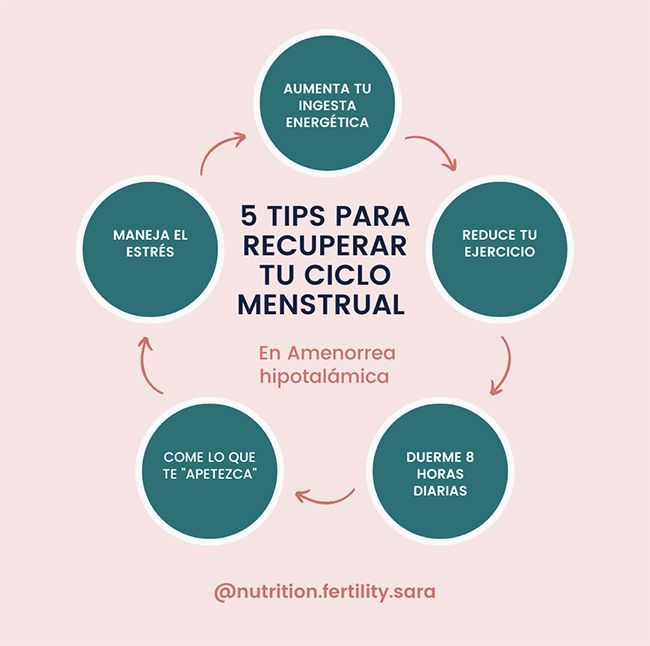
The good news is yes! HA is correctable and reversible. You can overcome HA through proper and personalized nutrition, body replenishment, rest and stress reduction.
I must say that recovering from hypothalamic amenorrhea is not an easy process to navigate, which requires hard work on a mental level. However, a large part of the management of HA can be done through lifestyle changes. That is why it is essential that you ask for help and get the support of a multidisciplinary team that may include: doctor, gynecologist and/or endocrinologist, DIETITIAN and psychologist.
Without further delay, below are some of the key dietary and lifestyle strategies for the management and control of HA:
- Increase total energy intake through foods with a high nutritional density: this may mean gradually increasing the frequency of meals and snacks and/or portion sizes, increasing the intake of fats, carbohydrates and/or proteins according to your unique needs.
- Introduce an adequate amount of carbohydrates in your diet: such as brown rice, whole wheat pasta, potato, sweet potato, quinoa, oat flakes. The amount will be different for everyone!
- Introduce healthy fats to each of your meals: olives, avocados, olive oil, nuts and seeds, nut butters, salmon or other fatty fish.
- Reduce the intensity and/or frequency of your exercise: and shift more towards gentler forms of activity such as Pilates, yoga, walking, etc. It may also mean incorporating rest days from physical activity if you train daily or most days of the week.
- Ensure adequate intake of calcium and vitamin D (either through dairy or other sources): for bone health. Get a blood test to check your levels, as well as it is important that you get a scan to monitor bone mineral density. Discuss with your doctor or dietitian if a supplement is right for you.
Some sources of calcium: dairy products (milk, cheese or yogurts), fish containing bones (such as sardines), tofu, green leafy vegetables or soybeans.
Some sources of vitamin D: oily fish (such as salmon), eggs, mushrooms and some cheeses.
- Eat what you “feel” like: break with “food rules” and the fear of certain foods. Work to achieve a healthy but flexible diet. Escape from rigidity and anxiety about food. Learn to give yourself permission to enjoy your favorite food without feeling guilty and continue eating in a healthy way.
- Manage stress: Whether you decide to put some mindfulness tool into practice or adopt a dog as a companion, you should look for the way that works best for you and best suits your lifestyle that helps you reduce stress.
- Sleep at least 7-8 hours a day: not sleeping the necessary amount of hours can have a negative role in your reproductive hormones (LH, FSH, estradiol and prolactin) thus interfering with your reproductive health.
- Spice up your levels of perfectionism: your struggle to achieve perfection leads to stress, disappointment and infertility, because, frankly, you are never going to achieve it. PERFECTION does not exist in real life, therefore it is time for you to put your needs first and your perfectionism second (or completely off your list).